
Visiting the sacred hill shrine of Lord Venkateswara at Tirumala is a profoundly spiritual experience. However, before you can step into the Vaikuntam Queue Complex, there is one strict regulation you must pass: the TTD Dress Code.
The Tirumala Tirupati Devasthanams (TTD) strictly enforces traditional attire to maintain the spiritual decorum, purity, and discipline of the divine space. According to the ancient Agama Shastras (temple traditions), the way a devotee dresses reflects their humility and respect for the deity.
Whether you are booked for a ₹300 Special Entry Darshan, a high-level VIP Break Darshan, or joining the free Sarva Darshan line, arriving in the wrong clothes will result in being turned away by temple security.
Here is the complete, updated 2026 guide to the Tirupati dress code for ladies, gents, and children, including what to wear during winters, what is strictly banned, and how to fix a wardrobe mistake at the last minute.
Official Tirupati Dress Code for Ladies
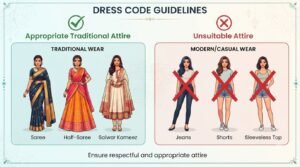
The dress code for women is strictly monitored. The temple authorities require women to dress modestly, covering their shoulders, chest, and legs completely. The goal is to wear simple, devotional attire that aligns with Hindu traditions.
Allowed Outfits for Women:
- The Saree: A traditional Indian saree worn with a blouse is the most highly recommended and universally accepted attire for women in Tirumala.
- The Half-Saree (Langa Voni): Traditional half-sarees (popular in South India) worn with a blouse are perfectly acceptable.
- Salwar Kameez / Chudidar (With a Catch): You are fully allowed to wear a standard Punjabi dress, chudidar, or salwar kameez. However, it must be worn with a dupatta (chunni). The dupatta must be properly draped over both shoulders to cover the chest. If you wear a kurta or salwar suit without a dupatta, security will stop you.
Strictly Banned Outfits for Women:
The TTD has a zero-tolerance policy for modern, casual, or western wear. Do not wear:
- Jeans, jeggings, or low-waist denim of any kind.
- Shorts, skirts, or dresses (even if they are ankle-length maxi dresses).
- Sleeveless tops, crop tops, or T-shirts.
- Nightpants, track pants, or yoga leggings (even if worn under a long kurta).
Official Tirupati Dress Code for Gents
The rules for men are highly specific, and the enforcement often depends on the exact type of darshan ticket you hold.
Allowed Outfits for Men:
- Dhoti (Pancha / Veshti) with Kurta or Bare Chest: A traditional white dhoti is the gold standard for men. You can pair it with a traditional kurta, an upper cloth (angavastram), or walk bare-chested (which is customary in many South Indian temples).
- Kurta-Pyjama: A clean, simple, traditional kurta-pyjama set is perfectly acceptable for most darshan types.
- Formal Wear (For standard darshans only): If you do not have traditional clothes, formal pants (trousers) and a button-down formal shirt are generally accepted for the free Sarva Darshan or ₹300 Special Entry Darshan.
Strictly Banned Outfits for Men:
- Jeans, ripped denim, or cargo pants.
- Shorts, Bermudas, or three-quarter pants.
- T-shirts (especially those with graphic prints, logos, or slogans).
- Tracksuits, gym wear, or lungis (lungis are considered casual home-wear, not temple-wear).
VIP Break Darshan vs. Standard Darshan
It is crucial to understand that the TTD enforces the dress code much more strictly for VIPs.
- For ₹300 Special Entry & Free Darshan: Security is slightly lenient with men. Formal trousers and a plain shirt will usually pass without issue. Women must still strictly wear a Saree or Salwar with a Dupatta.
- For SRIVANI Trust & VIP Break Darshan: The rules are absolute. Men must wear a traditional Dhoti/Pancha with an Angavastram or Kurta. Formal pants and shirts are strictly banned in the VIP lines. Women must wear a Saree or a classic traditional outfit. Do not attempt to bend the rules if you hold a VIP ticket.
Dress Code for Children and Infants
Parents often wonder if the strict rules apply to their little ones. The TTD provides a bit of leniency for children, but modesty is still expected.
- Infants and Toddlers (Ages 0 to 5): There is no strict dress code. They can wear comfortable cotton clothes, shorts, or frocks.
- Young Children (Ages 6 to 11): They should ideally wear traditional or formal clothes. Boys can wear trousers and shirts (no shorts), and girls can wear long skirts, frocks, or traditional pattu pavadas (lehengas).
- Teenagers (Ages 12 and above): They are treated as adults and must strictly follow the adult dress code (Sarees/Salwars for girls; Dhotis/Formal pants for boys).
What Happens if You Arrive in the Wrong Clothes?
If you arrive at the Vaikuntam Queue Complex wearing jeans or a T-shirt, the security personnel will immediately pull you out of the line and refuse entry. This can be devastating if you have a timed ticket.
However, there is an easy fix.
The local vendors in Tirumala are well aware of this rule. If you are turned away, simply walk to the nearest roadside stall outside the temple complex.
- For Men: You can buy a ready-made, wrap-around cotton Dhoti (Pancha) for ₹100 to ₹200. You can simply wear it directly over your jeans or trousers in the changing rooms or public restrooms nearby.
- For Women: You can easily purchase a loose Dupatta for ₹100 to drape over your kurta to satisfy the security guards.
Winter vs. Summer: Seasonal Clothing Adjustments
Tirumala is situated in the hills, and the weather dictates what is comfortable.
- Summer (March to June): The stone floors of the temple get incredibly hot. While you cannot wear footwear, you are allowed to wear thick cotton socks to protect your feet from burning while standing in the outer queues. Stick to lightweight, breathable cotton sarees and dhotis.
- Winter (November to February): It can get quite chilly at night and early in the morning on the hills. Yes, sweaters and jackets are allowed. You can wear a simple cardigan, a formal sweater, or a thermal inner-wear under your traditional clothes. However, avoid highly fashionable leather jackets or hoodies with massive logos.
Other Essential Etiquette Rules Inside the Temple
Your clothing is only the first step. To ensure a peaceful darshan, you must also adhere to the physical discipline of the temple:
- No Footwear: Shoes, sandals, and slippers must be removed well before entering the queue complex. Free shoe-keeping counters are available across Tirumala.
- No Electronics: Mobile phones, smartwatches, iPads, and cameras are strictly banned. You will be scanned multiple times. Deposit them in the free cloakrooms before joining the line.
- Applying Tilak: While not strictly mandatory, it is highly encouraged and deeply respected for men and women to apply a traditional Tilak, Vibhuti, or Kumkum on their forehead before entering the sanctum.
- Physical Cleanliness: Bathing before your darshan is considered an essential spiritual requirement.
Frequently Asked Questions (FAQs)
Can we go to Tirupati during periods?
According to traditional Hindu temple customs and Agama Shastras, women are strictly advised not to visit the Tirumala temple or participate in any darshan or sevas during their menstruation cycle. It is customary to wait until the 5th or 6th day after the cycle has ended, followed by a head bath, before visiting the temple.
Are black clothes allowed in Tirupati?
Yes, black clothes are allowed for regular devotees, though many prefer to wear bright, auspicious colors like yellow, red, or white. The exception is Ayyappa Swamy devotees, who traditionally wear black during their pilgrimage.
Can I wear a smartwatch if it is switched off?
No. Security guards cannot verify if a smartwatch is fully disabled. All digital watches and smartwatches will be confiscated or you will be asked to return to the cloakroom. Only traditional, analog mechanical watches are permitted.
Conclusion
The Tirupati dress code might seem strict to a modern traveler, but it is a beautiful equalizer. When millions of people from all walks of life—CEOs, farmers, politicians, and students—stand in the queue wearing the same simple, traditional attire, it strips away ego and societal status.
Pack a comfortable cotton saree or a traditional dhoti in your luggage, keep a dupatta handy, and leave your jeans in your hotel room. By respecting the traditions of the hill, you ensure your journey to see Lord Balaji is smooth, respectful, and spiritually uplifting.